The digital marketing space is a complex ecosystem that demands agility, innovation, and scalability. Adobe Experience Manager (AEM) sits at the heart of this ecosystem, providing robust content management solutions. Most important decision for organizations leveraging AEM is the choice of deployment: AEM 6.5 or AEM as a Cloud Service (AEMaaCS). Let’s dive deep into a comparison of both, outlining their pros and cons, and discover which deployment aligns with various business and technical needs.
AEM 6.5: The Seasoned Contender
AEM 6.5 is the tried and true on-premise version that many enterprises have relied upon for years. It’s a powerhouse for those who need absolute control over their CMS.

Key Components:
- Author Instance: Content authors interact with the authoring environment to create and manage content. By default, only one AEM author instance is available for authoring. If MongoMK is used, it allows for multiple authoring environments served from the same repository Mongo cluster (recommend for cases with high authoring activity)
- Publish Tier: Each publish instance serves published content to end-users. Operated using a farm-based model, allowing for the dynamic addition and removal of publish instances based on traffic demands and performance requirements.
- Dispatcher: Sits in front of the publish instances to improve performance and security. Caches and serves static content, such as HTML, CSS, and JavaScript files, and forwards dynamic requests to the appropriate publish instance. Helps reduce the load on publish instances and improves scalability and reliability.
- Content Delivery Network (CDN): A CDN caches and distributes content globally, reducing latency and improving user experience by serving content from edge servers closer to end-users.
- Load Balancer: A load balancer distributes incoming traffic across multiple AEM publish/dispatcher instances, improving scalability, reliability, and performance by ensuring efficient resource utilization.
Pros:
- Granular Control: Offers deep customizability and fine-tuning capabilities.
- Stable Performance: Well-understood and tested for various enterprise scenarios.
- Data Governance: Enables organizations to handle their data within their premises, a boon for strict compliance and regulatory needs.
Cons:
- Infrastructure Management: Requires a dedicated team for maintenance and updates.
- Cost: Higher upfront investment in infrastructure and licensing.
- Agility: Slower to adapt to new features and updates compared to cloud-based services.
Recommendation Criteria:
- For businesses with strict regulatory compliance and data sovereignty concerns.
- When you have the resources to manage infrastructure and prefer long-term investment stability.
AEM as a Cloud Service: The Modern Pioneer
AEMaaCS is Adobe’s cloud-native solution that offers flexibility, scalability, and a suite of modern tools that are continuously updated.
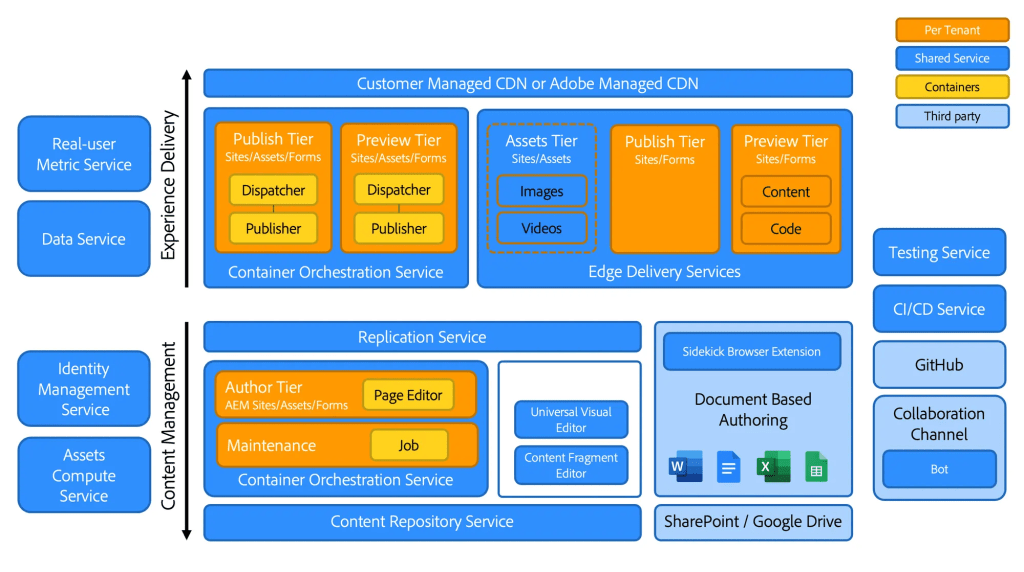
Components:
- Containerized Deployment: Author and Publish tiers are implemented as Docker containers, orchestrated by a Container Orchestration Service.
- Author Tier: Operated as a cluster of AEM author pods sharing a single content repository. Allows for business continuity during maintenance with at least two pods.
- Publish Tier: Operated as a farm of AEM publish instances, each with its own content repository. Scales dynamically to accommodate traffic fluctuations.
- Preview Tier: Comprised of a single AEM node for quality assurance of content before publishing.
Innovations:
- Cloud Data Store Integration: All files are directly uploaded and served from a Cloud Data Store, enhancing scalability and speeding up tasks like image and video handling.
- Subscription-based Content Publishing: Publishing operations follow a pipeline with a subscription pattern, enabling rapid autoscaling of the publish tier.
- Separation of Application Content and Code/Configuration: Code and configuration are immutable and baked into the baseline image, ensuring consistency and enabling global changes via Cloud Manager pipelines.
- Microservices on Serverless Technology: Leveraging serverless microservices, especially with Adobe I/O runtime, enhances scalability, agility, and resource efficiency.
Pros:
- Scalability: Auto-scales to meet demand without manual intervention.
- Innovation: Quick access to the latest features and security updates.
- Reduced Overhead: Adobe manages infrastructure, reducing the need for dedicated internal resources.
Cons:
- Customizability: Some limitations compared to the on-premise version, particularly with deep custom integrations.
- Transition: Requires existing AEM users to adapt to new cloud-native practices and workflows.
Recommendation Criteria:
- For organizations that prioritize speed-to-market and innovation.
- When scaling needs fluctuate or spike based on seasonal or promotional activities.
Detailed Comparison of AEM and AEMaaCS from a Business Perspective
| Criteria | AEM 6.5 (On-Premise) | AEM as a Cloud Service (AEMaaCS) |
|---|---|---|
| Cost Model | Capital expenditure (CapEx) with higher upfront costs for infrastructure. | Operational expenditure (OpEx) with a pay-as-you-go, subscription-based model. |
| Ownership | Full control over the CMS, including data governance and compliance. | Adobe handles infrastructure, offering a managed service experience. |
| Maintenance | Requires in-house maintenance, updates, and management. | Managed by Adobe, reducing the need for dedicated maintenance staff. |
| Control | Full control over the CMS environment and data. | Some control is relinquished to Adobe for ease of management. |
| Scalability | Manually scaled; requires forecasting and planning for infrastructure. | Automatically scales based on demand to accommodate growing needs |
| Compliance | Suited for stringent compliance and data sovereignty requirements. | Compliance managed by Adobe; may not meet all specific regulatory requirements. |
| Upgrade Path | Manual upgrades which can be costly and time-consuming. | Continuous updates and feature rollouts without manual intervention. |
| Investment | Long-term investment in infrastructure with a focus on stability. | Minimal upfront investment, focusing on agility and innovation. |
| Cloud-Exclusive Features Access | Limited access to cloud-exclusive features | Access to cloud-specific features and services for enhanced functionality |
Detailed Comparison of AEM and AEMaaCS from a Technical Perspective
| Parameter | AEM 6.5 (On-Premise) | AEM as a Cloud Service (AEMaaCS) |
|---|---|---|
| Architecture | Monolithic application, suitable for deep customizations. | Microservices-based, cloud-native architecture. |
| Asset Performance | Performance dependent on in-house capabilities and optimizations. | Enhanced by cloud capabilities with micro-service based architecture for asset processing |
| Code Changes | Direct changes to code can be done on server with appropriate credentials. | Direct changes to code are not allowed. The code needs to be deployed via Cloud manager only |
| Local Development & Testing | Local AEM needs to be updated with higher Service Pack only when similar upgrade is planned for Server. | Local development SDK should be updated regularly to keep up with AEMaaCS version |
| Customization | High degree of customizability for unique enterprise needs. | Some limitations in customization due to the standardized cloud approach. |
| Deployment | Flexibility in using any CI/CD tool. | Requires the use of Adobe’s Cloud Manager for deployment. |
| DevOps Resource Allocation | DevOps resources need to focus on server maintenance and updates | DevOps resources can focus more on reliability and innovation as server management is handled by the cloud |
| OSGI Configurations | Can be accessed and modified at any time directly in the environment. | Managed as code; no direct access to configurations in production environments. |
| Content Management | No specific constraint between mutable and immutable content. | Strict separation of mutable and immutable content. |
| Dispatcher Configuration | Flexible and customizable to meet specific needs. | Standardized as per cloud manager specifications. Some-level of customization is allowed |
| Downtime and Disruptive Releases | Periods when the system is unavailable or disrupted during software updates or maintenance | Updates and maintenance can often be performed seamlessly without downtime |
| Infrastructure | Managed by the organization. Requires a dedicated infrastructure team. | Fully managed by Adobe, with infrastructure abstracted away from the user. |
| Security Updates | Deployed manually, requiring careful planning and testing. | Deployed automatically, ensuring timely application of security patches. |
Making the Choice
Ultimately, choosing between AEM 6.5 and AEMaaCS depends on where your organization sees value. AEM 6.5 is like owning a custom-built house—full control but with more responsibilities. On the other hand, AEMaaCS is like a modern, managed apartment with amenities on demand—less control but more convenience.
By considering the pros and cons of each system, alongside your organization’s unique needs and strategic direction, you can make an informed decision that positions your business at the forefront of digital experience management. Remember, the platform you choose today will pave the way for the experiences you deliver tomorrow. Choose the path that aligns with your vision, resources, and customer engagement goals.
References:
 Adobe Experience Cloud Blog